
From Caddo Lake to underground aquifers, every drop counts
Story and photos by Joycelyne Fadojutimi/www.infinitieplusmag.com
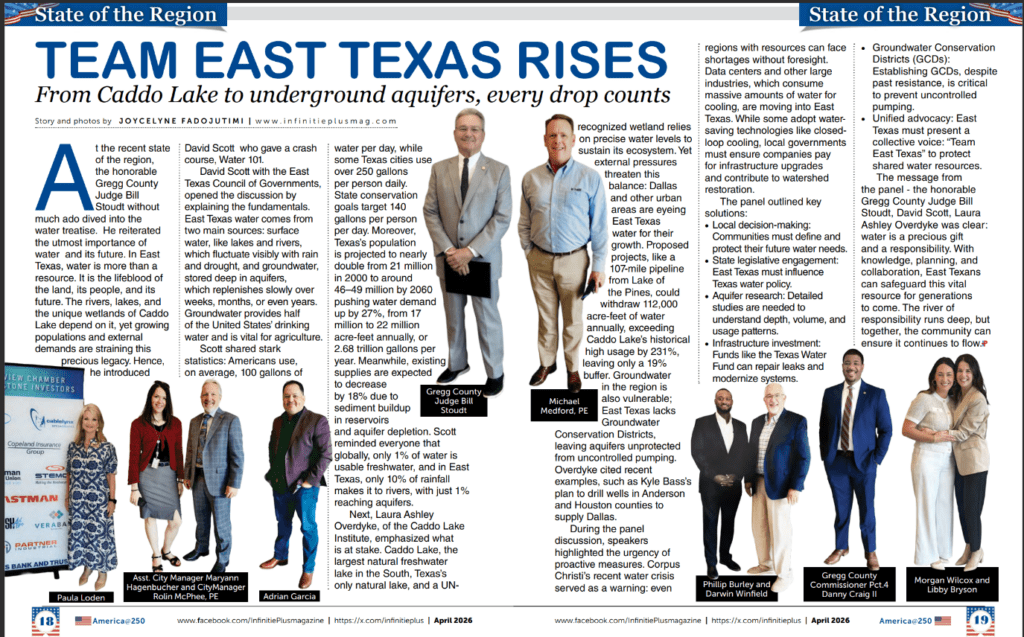
At the recent state of the region, the honorable Gregg County Judge Bill Stoudt without much ado dived into the water treatise. He reiterated the utmost importance of water and its future. In East Texas, water is more than a resource. It is the lifeblood of the land, its people, and its future. The rivers, lakes, and the unique wetlands of Caddo Lake depend on it, yet growing populations and external demands are straining this precious legacy. Hence, he introduced David Scott who gave a crash course, Water 101.


David Scott with the East Texas Council of Governments, opened the discussion by explaining the fundamentals.
Pictured: David Scott, PhD. (Photo taken by: LACC)
East Texas water comes from two main sources: surface water, like lakes and rivers, which fluctuate visibly with rain and drought, and groundwater, stored deep in aquifers, which replenishes slowly over weeks, months, or even years. Groundwater provides half of the United States’ drinking water and is vital for agriculture.

Scott shared stark statistics: Americans use, on average, 100 gallons of water per day, while some Texas cities use over 250 gallons per person daily. State conservation goals target 140 gallons per person per day. Moreover, Texas’s population is projected to nearly double from 21 million in 2000 to around 46–49 million by 2060 pushing water demand up by 27%, from 17 million to 22 million acre-feet annually, or 2.68 trillion gallons per year.

Meanwhile, existing supplies are expected to decrease by 18% due to sediment buildup in reservoirs and aquifer depletion. Scott reminded everyone that globally, only 1% of water is usable freshwater, and in East Texas, only 10% of rainfall makes it to rivers, with just 1% reaching aquifers.

Next, Laura Ashley Overdyke, of the Caddo Lake Institute, emphasized what is at stake.
Pictured: Laura Ashley Overdyke (Photo taken by LACC)
Caddo Lake, the largest natural freshwater lake in the South, Texas’s only natural lake, and a UN-recognized wetland relies on precise water levels to sustain its ecosystem. Yet external pressures threaten this balance: Dallas and other urban areas are eyeing East Texas water for their growth. Proposed projects, like a 107-mile pipeline from Lake of the Pines, could withdraw 112,000 acre-feet of water annually, exceeding Caddo Lake’s historical high usage by 231%, leaving only a 19% buffer. Groundwater in the region is also vulnerable; East Texas lacks Groundwater Conservation Districts, leaving aquifers unprotected from uncontrolled pumping. Overdyke cited recent examples, such as Kyle Bass’s plan to drill wells in Anderson and Houston counties to supply Dallas.

During the panel discussion, speakers highlighted the urgency of proactive measures. Corpus Christi’s recent water crisis served as a warning: even regions with resources can face shortages without foresight. Data centers and other large industries, which consume massive amounts of water for cooling, are moving into East Texas. While some adopt water-saving technologies like closed-loop cooling, local governments must ensure companies pay for infrastructure upgrades and contribute to watershed restoration.
The panel outlined key solutions:
- Local decision-making: Communities must define and protect their future water needs.
- State legislative engagement: East Texas must influence Texas water policy.
- Aquifer research: Detailed studies are needed to understand depth, volume, and usage patterns.
- Infrastructure investment: Funds like the Texas Water Fund can repair leaks and modernize systems.
- Groundwater Conservation Districts (GCDs): Establishing GCDs, despite past resistance, is critical to prevent uncontrolled pumping.
- Unified advocacy: East Texas must present a collective voice: “Team East Texas” to protect shared water resources.

The message from the panel – the honorable Gregg County Judge Bill Stoudt, David Scott, Laura Ashley Overdyke was clear: water is a precious gift and a responsibility. With knowledge, planning, and collaboration, East Texans can safeguard this vital resource for generations to come. The river of responsibility runs deep, but together, the community can ensure it continues to flow.